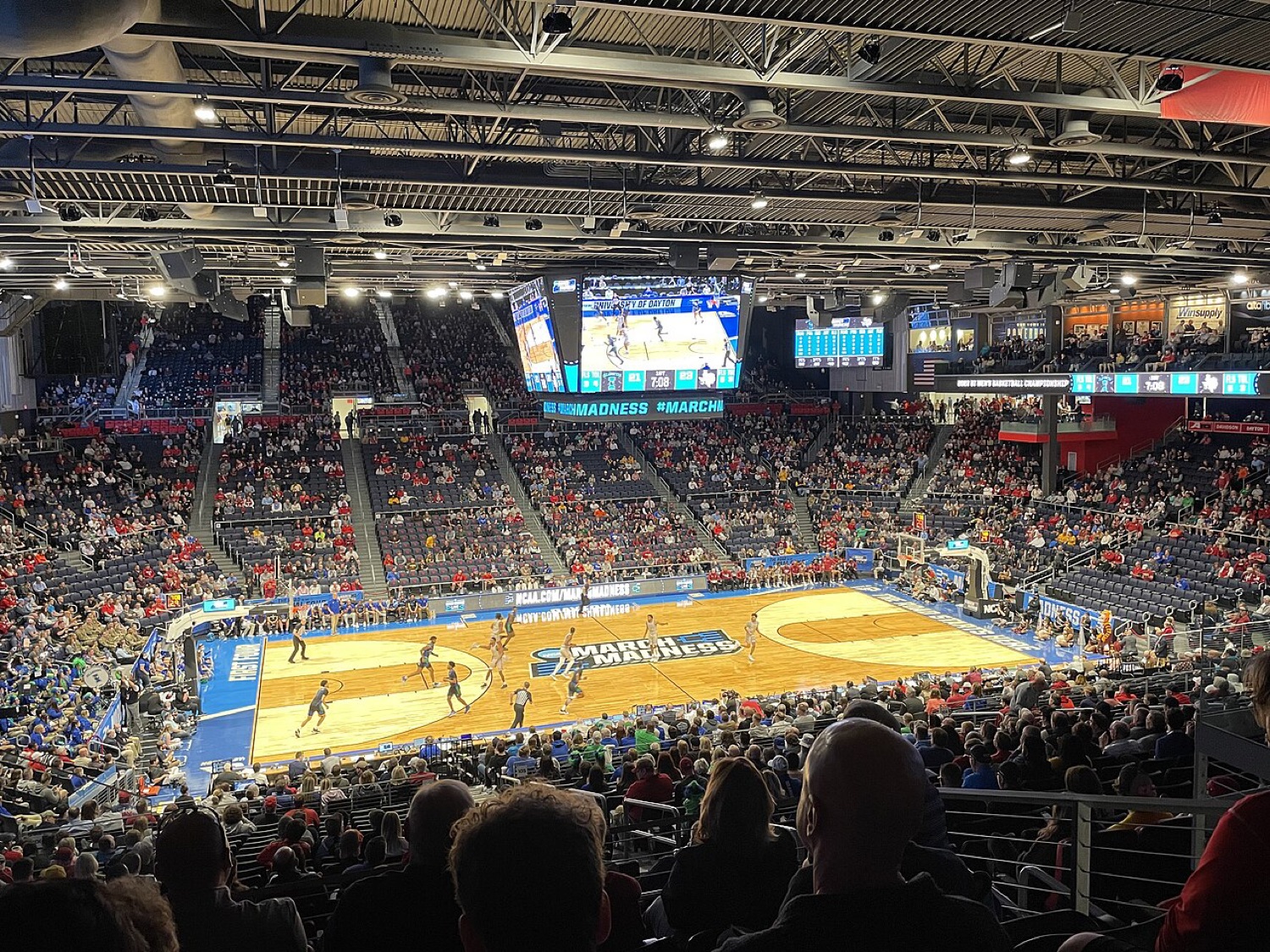
Every March, millions of people fill out a bracket for the college basketball tournament, drop it into an office pool or a free online contest, and watch it fall apart by the second afternoon. That is not bad luck. It is arithmetic.
Why perfect brackets do not happen
Leave out the four play-in games (the "First Four") and the men's tournament has 63 games. If every game were a coin flip, the number of possible brackets would be 2 to the power of 63, which is roughly 9.2 quintillion. Basketball knowledge improves those odds enormously, because number-one seeds almost never lose in the first round, but even generous estimates still leave a perfect bracket in the territory of one in many billions. Nobody has a verified perfect bracket for the full men's tournament, and you should not plan on being first.
How pools are usually scored
Most pools reward later rounds more heavily, often doubling the points each round. A common setup looks like this:
| Round | Games | Points per correct pick |
|---|---|---|
| Round of 64 | 32 | 1 |
| Round of 32 | 16 | 2 |
| Sweet 16 | 8 | 4 |
| Elite Eight | 4 | 8 |
| Final Four | 2 | 16 |
| Championship | 1 | 32 |
Under that scoring, each round is worth the same total, and your champion pick alone can be worth as much as the whole first round. That is the single most important fact about bracket strategy.
Habits that win more pools
- Pick a champion who can actually win, but not the one everybody picks. In a big pool, sharing the most popular champion with half the office means you need to beat all of them elsewhere.
- Choose first-round upsets sparingly. A couple of well-chosen upsets are fine; ten of them mostly cost you points.
- Look at the size of the pool. In a pool of eight friends, play it safe. In a pool of five hundred strangers you need some differentiation to finish first.
- Fill it out once. Tinkering after a late-night highlight package rarely helps.
Office pools are a social ritual first. Keep entry fees friendly, agree the rules before tip-off, and let the person with the worst bracket pick next year's lunch spot. The same probability thinking applies to the lottery, which we covered in Lottery Jackpots and the Odds Nobody Reads.